I am outlining for a novel (something I've never done before with any success) and it's set mostly in the country of Rinadrion, a very warlike country. Part of the plot has to do with a small percentage of the country's inhabitants who are deridingly called Kriones by their fellow countrymen. So, what exactly are Kriones?
If you'll remember from my post about Rinadrion, there is a small, mostly isolated group that have gone to the opposite extreme of trying to invade and take over every other country in the world, and are pacifists, shunned and ostracized by their countrymen. Krione is taken from Kriona, the goddess of peace, prosperity, and comfort. Basically, they're being called cowards.
The character in my novel who is a Krione is not a full pacifist. He is conflicted about what role violence should play in a man's life; whether it is fine to kill in self-defense or to defend one's country if it is invaded.
As you can see, something like this has the potential to be really interesting if explored. If you'd grown up in a country like Rinadrion, yet realized there was something wrong with their constant warmongering, would you go to the opposite extreme and become a pacifist? Or would you be really conflicted, not knowing if you should kill, or what the right reasons for killing were?

Tuesday, May 29, 2012


Thursday, May 10, 2012
Customs of Arvindia, as Observed by a Rinadrion (Part One)
Hi, everyone! I know it's been ever so long since I last posted, and I'm sorry for that. I decided I'd start a new series on worldbuilding, inspired by Aubrey Hansen, who makes the best worldbuilding posts I've ever read. Seriously, the things she comes up with are amazing! I hope I can match up a little bit to her creativity.
I figured that instead of a dry dissertation on my world, I could write 'essays' of a sort, written by an outsider who observes the country through foreign eyes. This one is written by a Rinadrion (you can read about the country of Rinadrion here.), and part one is concerned mostly with celebrations. I hope ya'll enjoy this, and you can be looking forward to more posts soon! As always, questions are welcome :D
**********************************************************************
I figured that instead of a dry dissertation on my world, I could write 'essays' of a sort, written by an outsider who observes the country through foreign eyes. This one is written by a Rinadrion (you can read about the country of Rinadrion here.), and part one is concerned mostly with celebrations. I hope ya'll enjoy this, and you can be looking forward to more posts soon! As always, questions are welcome :D
**********************************************************************
I have noted many interesting customs of the Arvindians in my travels through their land. One is the celebrating of birthdays every year. For most, who have many children, not to mention a great deal of kin, a simple wishing of good fortune throughout the coming year is customary. Like my own countrymen, they celebrate the coming of age with a gift and, if the family is wealthy enough they will give a celebration feast, but this is rare except among the nobility. In Arvindia, the age when a male child becomes a man is between fourteen and fifteen, while for a female the age is thirteen. I find this ludicrous, given that our own boys become men at thirteen, at the same age as our girls. But, however that may be, their celebrations are mostly simple, even among the nobility, and not such a great occasion as in my own land.
One of their oddest celebrations is the giving of a gift to any child under the age of twelve born on the crown prince’s birthday. In all my travels, I have come across only five such children, and none of them knew each other. How this practice came into being I have not yet found out.
The Arvindians also celebrate the coming of their forefathers to this land, escaping (as legend has it) from a mighty and malicious Sorcerer. On this occasion, all superfluous work is put aside and there is feasting and song. I will note here that the Arvindians are a people singularly blessed with beautiful voices; and their music is a thing not to be missed. They are a simple people, and sing songs on every subject under the sun, and rarely is even such a mundane thing as the baking of bread made tiresome by being put into verse.
They are a plain and hardy people, most of them living in small villages and fending for themselves. Their feasts tend (save in the great cities) to be of those things which our Rinadrions doctors would find coarse and bad for the heath. Nevertheless, the thick brown bread, rice, strong cheese, apples, and mutton which they eat seem not to affect their health, for they are robust and have great, hearty laughs.
At the Founding celebration which I attended, a farmer was asked to give a speech, which he promptly did. It was very bad grammar, and our orators would have been horrified had they heard it, but it was a good speech, in its own way: full of musings on good soil (which they have in abundance) and on the king (whom they admire for staying out of their business for the most part) and eliciting a cheer when, breathless, he stopped and downed a glass of ale.
The Arvindians hold another celebration at the beginning of harvest, during which any man with sons to spare sends them to his neighbor to join in the reaping. At these times, the whole village will dine together in the market, and there is a great joviality of spirit, especially if the year has been a good one (as it was when I traveled through).
Besides these, there are many festivities which go on among them to varying degrees.
If a child is born, it is customary to send a large cheese or a loaf of bread to the mother. If twins are delivered, the father will in some places bring his new children out into the middle of the village or city to have them blessed by his neighbors (as well as being given gifts).
The marriage celebration goes thusly:
When a man is to take a wife, he and she will go into the center of their village or city, where the father and mother of the woman are already waiting. After this, the man’s parents also come. All are dressed in their best. The man takes a white rose, or another flower if roses are not in season) and breaks off the thorns with his own hands. He then puts it in her hair. After this, they kneel down, facing one another, and the magistrate takes the right hand of the woman and puts it in the right hand of the man. They are then pronounced husband and wife in the sight of Enderel and their families, and congratulations are given. After this, the woman takes the white rose from her hair and gives it to the man, who places it in his tunic or shirt by his heart.
The festivities are joyous; though only the parents and the magistrate are present at the wedding, all the village is invited to the feast. There the man and his wife take a place of honor, but are not allowed to be spoken to by anyone but each other for the first half hour. It is then customary for the husband to give a speech, in which he recounts the tale from when he first saw his wife until their marriage.
Gifts are sent to the home of the newlywed couple anonymously. When I asked why the gifts had no labels or anything to signify who had sent it, I was given this reply, “It prevents them being worried about searching out the giver and thanking him. They wouldn’t want to be troubled about that when they are only thinking of each other.”
Thursday, April 19, 2012
Book Giveaway!
A fellow Christian fantasy author, Brian, is giving away a hardcover trilogy by Stephen Lawhead!
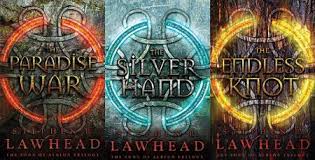
To enter is simple:
1. Start inviting people through Facebook, Twitter, Myspace, etc...
2. Repost this blog post to your own blog
3. Follow it yourself!
God bless!
Brian's blog-- http://jointhestarcrafters.blogspot.com/
To enter is simple:
1. Start inviting people through Facebook, Twitter, Myspace, etc...
2. Repost this blog post to your own blog
3. Follow it yourself!
God bless!
Brian's blog-- http://jointhestarcrafters.blogspot.com/
Saturday, April 7, 2012
A Story for Good Friday
My dear friend Kate has written a wonderful short story, told from the perspective of a Roman girl on the day of Christ's death. If you'd like to read it, you can go here or here.
I'll let you form your own opinions of it without my comments, but I have a feeling that you will really enjoy it, as I did :D
Have a wonderful Resurrection Day!
I'll let you form your own opinions of it without my comments, but I have a feeling that you will really enjoy it, as I did :D
Have a wonderful Resurrection Day!
Wednesday, March 21, 2012
Interview-Lee Duigon
Today I'm interviewing an actual, published author! Lee Duigon is the author of a series of Christian fantasy books. While I haven't read his books, I would love to; they sound very good :)

So, without further delay, the interview :)
Obst is an elderly hermit in Lintum Forest, who believes God will end the world once the bell is rung. His first impulse is to stop the children, but he winds up being their guide and helper.
Lord Reesh, the First Prester of the Temple, heads the institutional church in Obann. A thoroughgoing humanist with a gift for making the ends justify the means, Lord Reesh tries to ensure that the bell on Bell Mountain—if it really does exist—is not touched except on his orders. Reesh will take over as the dominant villain in the sequels.
So Reesh sends his assassin and secret agent, Martis, to follow the children up Bell Mountain, find out whether there really is a bell up there, and stop Jack and Ellayne from ringing it, either by killing them or capturing them and bringing them back to Reesh as prisoners.
Wytt—a little, hairy, manlike creature no bigger than a squirrel—appoints himself the children’s guardian on their travels. He is one of the “hairy ones” mentioned in the scriptures as inheriting the shapeless ruins that once were the great cities of Obann.
Helki the Rod, the wild and highly eccentric woodsman, will play a much-expanded role in the sequels.
It was only after the first three novels were published that I understood I had a theme common to all the books that are and will be in this series. They are about people who have lost God reconnecting with Him—learning how to speak to Him, learning how to hear His voice, learning how to seek Him with all their hearts. It is, of course, the power of God that calls them to Him. So I believe I can say my books are about redemption.
Taking a cue from C.S. Lewis’ “Chronicles of Narnia,” I don’t try to portray Christianity per se. After all, I’m not writing about our world, but a completely different one. Its history is different. The people in my fantasy world have not yet met their Savior. He has not yet been revealed to them—except in a few prophecies that they are a long way from understanding.
Instead, I have tried to infuse my fantasy world with a Biblical spirit—hopefully, prayerfully, with the Spirit of God. I am happy to say that a number of readers have told me that in this I have succeeded. One reader has said she finds it very hard to believe that the “scriptures” quoted in my novels are not actually hidden somewhere in the Bible, where’s she’s overlooked them. Comments like that tell me I’m on the right track.
So, without further delay, the interview :)
How long have you been writing?
My friends and I were telling each other made-up monster stories by the time I was 10. I wrote my first novel (in composition notebooks) when I was 13 or 14. So let’s say 50 years, at least.What was your first (written) story about?
Back in grade school, we were assigned to write stories in class. This would be second or third grade. The teacher would tell us what to write about and how to write it. The earliest one I can remember was “The Adventures of a Dime.” I rebelled against writing what the teacher wanted me to write, so in my store, a stray cat swallowed George the Dime; and he would’ve been stuck down there, only he met a character named Mr. Vomit who was on his way out and offered George a lift. I got into a tremendous amount of trouble for that! But to my amazement, my mother sided with me. Not an elegant story, I admit: but at least it showed a little flash of creativity.When did you start writing Christian fantasy? What inspired you to do so?
“Bell Mountain” was my first Christian fantasy. It came along as a response to one of the officers of the Chalcedon Foundation saying, “What we really need is novels.” That remark got back to me, and I wondered if I could write the kind of novel Chalcedon needed. I should add that my editor, Susan Burns, who knew about my earlier books, made sure that remark got back to me.Do you remember how you first got the idea for Bell Mountain?
In “Bell Mountain,” the boy, Jack, dreams he can hear the mountain singing. Well, I had that dream first! And quickly on its heels followed the image of a bell standing on the summit of a mountain, in the snow. That was all I needed to start writing the story—a radical departure from my usual procedure of thoroughly doping out a novel before I began to write it.Who are the main characters in Bell Mountain?
In the land of Obann—once a kingdom, once a powerful and wealthy empire, now a medieval oligarchy—live my two protagonists, Jack and Ellayne, a poor boy and a rich girl. These two children believe God has commanded them to climb Bell Mountain and ring the bell on the summit. Their quest is based on a powerful dream Jack had, and some scriptural teachings by an old man who never intended for Jack to take them literally.Obst is an elderly hermit in Lintum Forest, who believes God will end the world once the bell is rung. His first impulse is to stop the children, but he winds up being their guide and helper.
Lord Reesh, the First Prester of the Temple, heads the institutional church in Obann. A thoroughgoing humanist with a gift for making the ends justify the means, Lord Reesh tries to ensure that the bell on Bell Mountain—if it really does exist—is not touched except on his orders. Reesh will take over as the dominant villain in the sequels.
So Reesh sends his assassin and secret agent, Martis, to follow the children up Bell Mountain, find out whether there really is a bell up there, and stop Jack and Ellayne from ringing it, either by killing them or capturing them and bringing them back to Reesh as prisoners.
Wytt—a little, hairy, manlike creature no bigger than a squirrel—appoints himself the children’s guardian on their travels. He is one of the “hairy ones” mentioned in the scriptures as inheriting the shapeless ruins that once were the great cities of Obann.
Helki the Rod, the wild and highly eccentric woodsman, will play a much-expanded role in the sequels.
How much development have you done for your world, such as maps, cultures, different religions, etc.?
I do have a map—it gives me pleasure to begin a fantasy with a map—and I did start with a kind of vision of what kind of book I wanted to write. But in contrast to my usual procedure, I “discovered” the world of Obann as I wrote about it. This is funny—some reviewers have praised my description of the various peoples and cultures of my fantasy world, as if I’d spent years inventing them. Not so! This world’s history, geography, and natural history reveals itself to me as it unfolds. To me it seems to have an independent existence. Some of the details, as they emerged, surprised me. I know that seems a strange thing for a writer to say, but I can’t think of any better way to say it.What is your main theme in these books? Do you have a certain point that you try to make throughout the whole series?
It took me quite some time to realize what my theme was. At first, one of my intentions in these stories was to “re-normalize religion.” You know, in almost every piece of fiction we read or watch (movies, TV), the characters in it live in a complete absence of religious belief and practice. No such world as that has ever existed, in real life; I pray it never will. I wanted to write a fantasy tale—I’ve always loved fantasy, but had never had one of my fantasies published—based on something like this: “What if God—our God, the God of the Bible, Jehovah—created a world other than this one that we live in? A world for other people who would live following a completely different arc of history from our own?” This world would have the same God as we have, but it would be very different from ours in all sorts of interesting ways. In my “Bell Mountain” books, I have set out to explore this world and tell its story.It was only after the first three novels were published that I understood I had a theme common to all the books that are and will be in this series. They are about people who have lost God reconnecting with Him—learning how to speak to Him, learning how to hear His voice, learning how to seek Him with all their hearts. It is, of course, the power of God that calls them to Him. So I believe I can say my books are about redemption.
What role, if any, does feminism play in your books?
One of the truly wonderful things about writing fantasy is that you can leave all those “isms” behind, as if they didn’t exist. So I am happy to say feminism plays no role whatsoever in my books—although I do enjoy writing about strong and interesting female characters. After all, I want girls and women to enjoy reading them as much as boys and men.How supportive is your family of your writing?
My wife, Pat, has always believed in me as a writer, and never wavered—not even during those long years when I was cranking out story after story, book after book, and getting nothing but rejections. As for the rest of my family... well, just try impressing anybody who knew you while you were in diapers.Have you ever met a famous author, or one that you admire (whether famous or not)?
I met Arthur C. Clark once, at a science fiction convention (just to shake hands with), and Isaac Asimov even more briefly. I never met T.E.D. Klein in the flesh, but we corresponded back and forth for several years and talked together on the phone sometimes. Maybe you haven’t heard of him, but he was a truly gifted and original horror writer—had a New York Times best-seller once, “The Ceremonies.” As editor of the old Twilight Zone Magazine, he published one of my best short stories, “The Last Voyage of Sinbad.” Mr. Klein was always very encouraging to me, never failing to offer helpful suggestions. Unfortunately for readers, his own output was always a trickle when we would have loved a steady stream. As true an artist as he was, I learned that he much preferred editing to writing; and I think he prefers his privacy to his editing. God bless you, Ted, wherever you are.How many books will there end up being in your series?
I’m thinking seven (there are five written), but who knows? I have a whole world to explore. If I write about it for the rest of my life, I still won’t be able to write everything there is to tell.It's difficult to portray Christianity in a fantasy setting without making it sound stiff or 'preachy'; can you give us any tips on how you do it?
You’re right—it’s very difficult. Or at least it seems it should be. My habit is to read 5 chapters of the Bible every day, so as to steep myself in it, and to pray, asking the Lord to give me the story He wants me to tell.Taking a cue from C.S. Lewis’ “Chronicles of Narnia,” I don’t try to portray Christianity per se. After all, I’m not writing about our world, but a completely different one. Its history is different. The people in my fantasy world have not yet met their Savior. He has not yet been revealed to them—except in a few prophecies that they are a long way from understanding.
Instead, I have tried to infuse my fantasy world with a Biblical spirit—hopefully, prayerfully, with the Spirit of God. I am happy to say that a number of readers have told me that in this I have succeeded. One reader has said she finds it very hard to believe that the “scriptures” quoted in my novels are not actually hidden somewhere in the Bible, where’s she’s overlooked them. Comments like that tell me I’m on the right track.
Who is your favorite author?
I have a lot of favorites. C.S. Lewis excels in refreshing for me the image of Jesus Christ, and reminding me how much I love Him. I turn to Agatha Christie for insights into character; to Edgar Rice Burroughs as the master when it comes to juggling a complicated plot and keeping up the pace of the action; to Walter R. Brooks (“Freddy the Pig”) for gentle and unexpected humor; to Sir Walter Scott for confirmation that good really can triumph over evil, even in this fallen world; to J.R.R. Tolkien for simply igniting my imagination; and to other writers for other things. But the one book I read from every day, without fail, is the Bible. It’s the one book that can never get stale—positive proof it’s not an ordinary book! There’s always something new to discover, some fresh insight, in the Bible.Thank you so much, Mr. Duigon. This has been a very enjoyable and informative interview :) God bless!
For more about Mr. Duigon, you can visit his blog/website at leeduigon.com
You can find his Amazon page here and an archive of his articles here and by searching his name here.
I hope you all enjoyed this as much as I did. I think interviews are a lot of fun. Now, go and check out his books!
Subscribe to:
Posts (Atom)